
By Admin | September 12, 2025
In a manufacturing plant, the fluid travelling through a pipeline may carry dirt, rust, scale, or other unwanted particles. If these particles enter pumps, valves, heat exchangers, or other equipment, they can cause blockages and affect their normal operation. A strainer catches these unwanted particles before they move further into the pipeline.
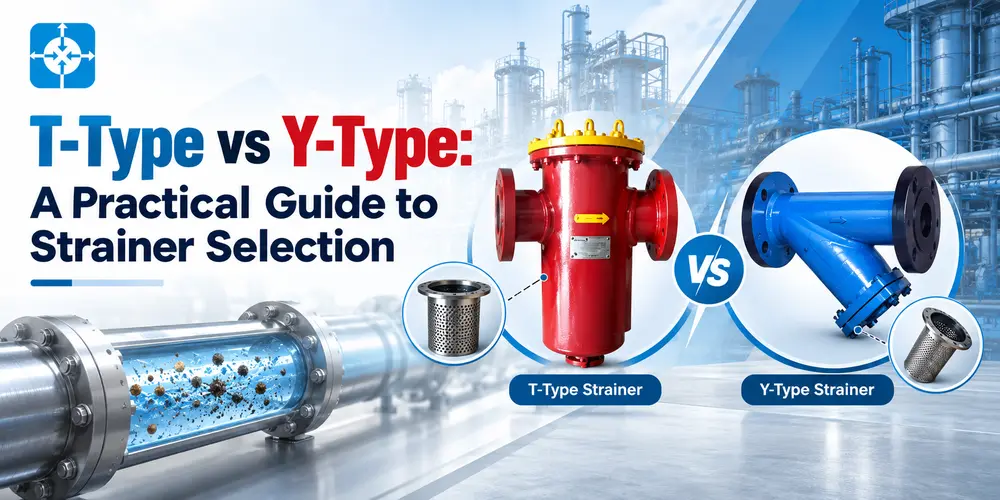
In industrial piping, there are two common designs of strainers: T-type and Y-type. Both strainers are used for filtration, but their design, installation, and maintenance needs are not the same. Knowing these differences helps industries to select a suitable option for their process.
A strainer is a mechanical filtration device installed in a pipeline to remove unwanted solid particles from a flowing medium. The process fluid passes through a perforated or mesh element, while particles larger than the openings are trapped inside.
The dimensions, material, filter element, and construction of a strainer vary depending on several aspects like the type of process fluid, the temperature, and the amount of contaminants.
A T-type strainer has a T-shaped body with the straining element fitted inside. Its construction can provide a practical filtration area and convenient access to the element for inspection and cleaning.
This type of strainer is considered for industrial applications where filtration capacity and maintenance access are important. The exact construction and material can be selected according to the process requirements.
For industries looking for a T-Type Strainer Manufacturer in India, it is important to consider the operating conditions rather than selecting a strainer based only on pipeline size.
A Y-type strainer has a Y-shaped body, with the straining element placed in the angled section. As the fluid enters, it passes through the screen while unwanted particles are collected inside the element.
The filtered fluid continues through the outlet and into the rest of the process line. When cleaning is required, the element can be removed and cleaned before being fitted back.
The compact arrangement of a Y-type strainer makes it useful where installation space needs to be considered. A Y-Type Strainer Manufacturer in Ahmedabad can provide suitable configurations based on the application, piping arrangement, and process conditions.
Although both designs remove unwanted particles, their construction makes them suitable for different installation and maintenance requirements.
| Feature | T-Type Strainer | Y-Type Strainer |
|---|---|---|
| Design | T-shaped | Y-shaped |
| Element | Inside the main body | In the angled section |
| Space | Needs more maintenance space | More compact |
| Cleaning | Easy element access | Element can be removed |
| Best suited for | Higher filtration and easy access | Space-limited installations |
T-type strainers can be used in chemical plants, pharmaceutical facilities, petrochemical units, power plants, water treatment systems, and other industrial process applications. They are useful where filtration and access to the straining element are important considerations.
Y-type strainers are commonly considered for pipelines where a compact arrangement is useful. They can be installed upstream of pumps, valves, heat exchangers, and other equipment requiring protection from solid particles.
They may be used across liquid, gas, and steam services, provided the strainer design and material are suitable for the operating conditions.
Selecting the right strainer depends on the process and the conditions in which it will be used. Before making a selection, factors such as the type of fluid, flow rate, pressure, temperature, particle size, filtration needs, available space, connection type, material of construction, and cleaning frequency should be considered.
At ProcEquip, these factors can be considered together to help identify a strainer that suits the pipeline arrangement and operating conditions. A suitable selection can help the strainer perform properly while making routine cleaning and maintenance easier.
T-type and Y-type strainers both provide an important filtration function, but their designs serve different practical requirements. Understanding the difference between them makes selection easier and helps protect downstream equipment from unwanted particles.
Procequip provides industrial strainer solutions for different process requirements. Discuss your application with our team to identify a suitable configuration for your piping system.
An industrial strainer filters the solids from process fluid which are not required before passing into other equipment like pumps, valves, and heat exchangers.
Yes, they perform the same function, which is the filtration of solids in the process line. But the difference lies in the body structure, design of the element, and maintenance procedure.
It depends upon the dirt in the process fluid; regular monitoring will tell whether the straining element should be cleaned.


