

By Admin | November 19, 2026
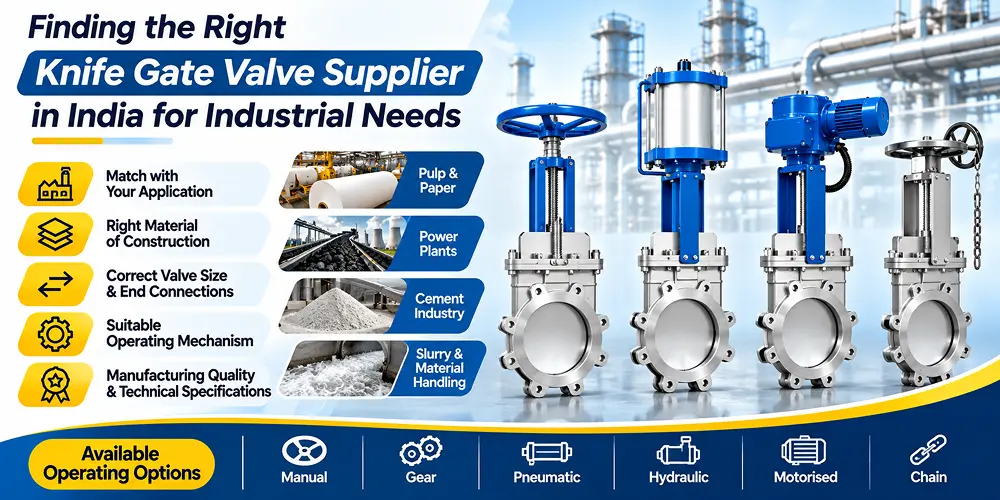
Selecting the right industrial valve helps keep your equipment in order and control the flow of liquid. If your equipment handles viscous liquid, abrasive slurries, pulp or even dry powder, choose a knife gate valve. These valves can cut through the suspended solids within the fluid medium.
Going for the cheapest valve is not always enough. There are many other factors to take into account, including material quality, design, type of valve, valve size and application area. With the help of a dependable Knife Gate Valve Supplier in India, you can get an appropriate valve. Process Equipment Corporation provides a wide range of industrial valves to different industries.
Selecting the right knife gate valve depends greatly on the industrial application. Every industry has its own requirements, and the valve must match them. For instance, the pulp and paper industry handles fibrous materials, while power plants handle coal, ash and wet or dry powders. Knife gate valves can be used for:
Material selection is essential, as it determines how the valve will perform in the selected fluid. The body and all other parts should withstand the temperature and pressure they will experience.
Different applications need different materials, such as carbon steel, stainless steel and grades like AISI 304 and AISI 316. The best Knife Gate Valve Supplier in India should provide relevant information on the materials used for industrial valves.
Valve size and end connections are critical for proper pipeline fitting. Incorrect sizing or connection selection may create difficulties during installation. When placing an order, consider the following:
A reliable Knife Gate Valve Supplier in India can help provide suitable valve connection options based on your pipeline requirements. Proper selection helps simplify installation and future maintenance.
The operating mechanism determines how the valve opens and closes. It depends on the valve size, the installation arrangement and the level of automation needed. Common mechanisms are:
It is always good to discuss this with the supplier.
It is important to look beyond manufacturing quality when choosing industrial valves. Buyers should check the specifications, materials, dimensions and test procedures before purchasing. Important specifications include the pressure class, design standard, valve size, material of construction (MOC), connection and valve operation.
Knife edge gate valves are available in sizes from 100 to 900 mm NB in the 150# pressure class and are designed according to the MSS SP-81 standard. They are best suited to pulp, slurry, powder and material handling. Analysing these specifications will help you choose valves suitable for your application.
An experienced supplier understands different industrial applications and technical needs. The buyer should consider the supplier’s manufacturing experience, products offered, materials and other specific capabilities. Knife edge gate valves are available in various materials, sizes, operations and connections. Dealing with an expert supplier enables buyers to get technical guidance before installation.
Selecting an industrial valve requires analysing requirements such as material, valve size, process and valve manufacturing, among others. These factors determine the suitability of the valve for the particular process.
When selecting a Knife Gate Valve Supplier in India, it is important to consider technical expertise, product specifications and the company’s experience in handling industrial applications. Process Equipment Corporation is a reliable choice for meeting these requirements.
Knife gate valves are used for isolation in pipeline systems carrying slurries, pulp, fibers, coal, ash, and dry or wet powders.
They are used in the pulp and paper industry, power plants, cement industries, mines, pneumatic conveying and material handling industries.
Manual, geared, pneumatic, hydraulic, motorised and chain-operated types are available. The right method can be chosen as per the requirements of the application.
Consider the valve size, materials of construction, operating pressure, end connection and type of operation.
Share the media of use, process conditions, pipe size and mode of operation.


