

By Admin | October 7, 2026
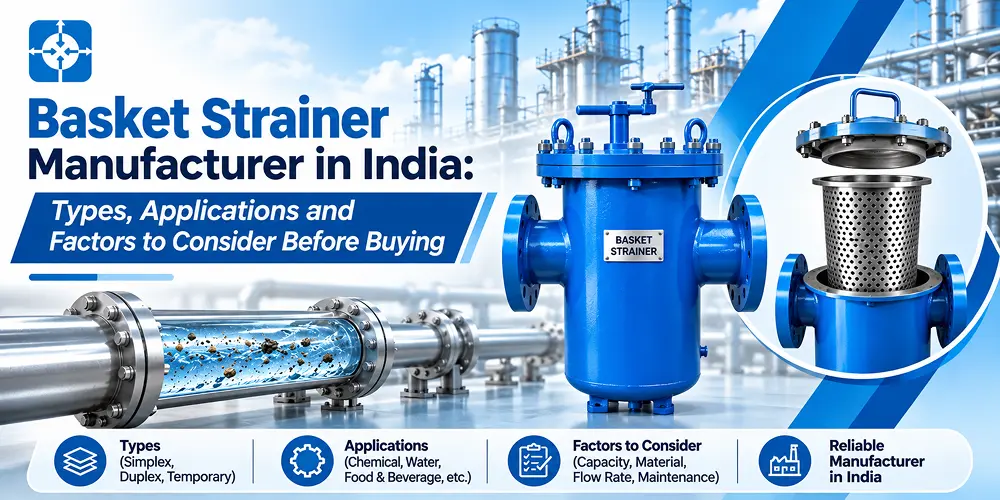
Solid particles in a process liquid can cause problems for pumps, valves, heat exchangers and other process equipment. A basket strainer helps to remove this unwanted material from the liquid stream before it travels further along the pipeline.
Process Equipment Corporation manufactures industrial strainers for different fluid-handling requirements. When looking for a reliable Basket Strainer Manufacturer in India, it is important to consider the filtration requirement, pressure, flow rate, materials, ease of maintenance and quality of construction.
A basket strainer is a mechanical filter that removes unwanted solid particles from a liquid stream. It typically includes a housing, a removable basket with holes or mesh, an inlet and outlet, and a cover.
As the liquid moves through the housing, it passes through the basket and the unwanted particles remain inside. The liquid then continues down the pipeline. Basket strainers are often used as a first line of protection for pumps, valves, heat exchangers and similar equipment.
The filtration depends on the basket sizing (holes or mesh) and material. This does not always mean fine filtration, so the design should be considered based on the required particle size, liquid properties, flow rate and the level of cleanliness needed.
A basket strainer works in a simple way:
Regular maintenance helps to keep the pressure drop from becoming too high.
There are a few main types of basket strainers, so it is useful to know what is available.
Simplex: A simplex basket strainer has only one basket. It is generally suitable for applications where the flow can be stopped to clean the basket. Its key points are a simple design and easy access to the basket, but the system needs to be isolated and depressurised for cleaning.
Duplex: A duplex basket strainer has two basket chambers that can be switched, so one can stay in use while the other is isolated for cleaning. It can provide continuous filtration and suits processes where stopping the flow is not desirable. However, it requires extra space and a switching mechanism, and is usually more complex than a simplex strainer.
Temporary: A temporary basket strainer is installed for a short period, often during commissioning or flushing of pipework, to capture debris. The design, pressure drop and removal should be decided based on the commissioning plan.
| Feature | Simplex Basket Strainer | Duplex Basket Strainer |
|---|---|---|
| Basket arrangement | One basket chamber | Two basket chambers |
| Cleaning | Usually requires flow interruption | Can allow cleaning of one chamber while the other operates |
| System complexity | Relatively simple | More complex due to the changeover arrangement |
| Space requirement | Generally lower | Generally higher |
| Typical application | Processes that can be stopped for maintenance | Processes requiring continuous filtration |
| Selection priority | Simplicity and maintenance access | Continuity of operation |
Depending on whether the process needs to keep running, the maintenance required, the space available and what happens when the flow is stopped, the correct design should be selected.
Basket strainers can be used in many industries, provided the material and design suit the process liquid.
When purchasing a basket strainer, it is important to consider several factors:
When looking for a basket strainer manufacturer in India, consider the fluid, pipe size, flow rate, pressure, temperature, filtration and installation. This helps in deciding the correct design and construction requirements.
Process Equipment Corporation, based in Vatva GIDC, Ahmedabad, manufactures industrial strainers and valves. Its strainer range includes basket, bag-type, duplex, T-type, Y-type and temporary strainers, along with strainer elements.
The right design depends on the application, so it helps to share your requirements early. Details such as the fluid, flow rate, pipe size, pressure, temperature, filtration level, material preference and quantity make it easier to identify a suitable basket strainer. Technical drawings and installation details can also be shared if available.
Basket strainers can help remove unwanted solid particles from compatible liquid streams and protect equipment further down the line. When selecting one, consider the flow rate, filtration, pressure, temperature, materials, ease of maintenance and whether continuous operation is needed.
If you are looking for a basket strainer manufacturer in India, Process Equipment Corporation can help you discuss your application and identify a suitable design.
Choose the basket size based on the particles you want to capture, the protection required and the flow rate. Also consider how often the basket may become blocked.
The material depends on the fluid, pressure, temperature and any corrosive conditions. Many applications use stainless steel, but the correct grade should be confirmed.
This depends on the amount and type of debris in the fluid, the basket size and the operating conditions. Monitoring the pressure drop and following a maintenance schedule can help decide when to clean.
Share the fluid, flow rate, pipe size, pressure, temperature, filtration requirement, material preference and quantity.


